Guide
How to Read Nutrition Labels: A Practical 5-Step Guide
Read a label in a fixed order. First establish the basis the numbers are declared on — per serving in the United States, per 100 g or 100 ml in the European Union. Then read calories, then protein and fibre, then saturated fat, sodium or salt and added sugars, then the ingredient and allergen statements. Finally, compare products on the same basis.
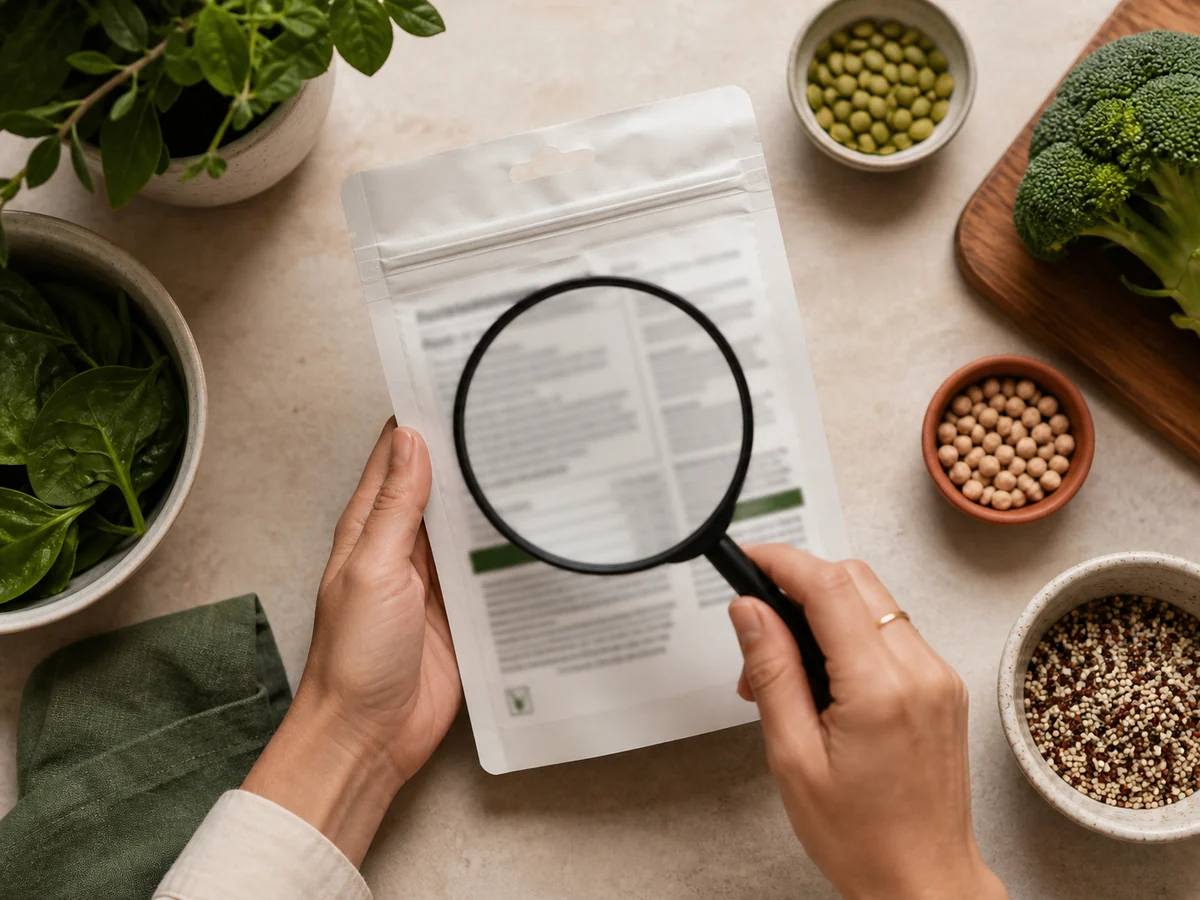
1. Establish the basis before you read a single number
Every value on a panel is meaningless until you know what it refers to. On the U.S. Nutrition Facts label the figures are generally declared per serving, and a package can contain several servings — so check the servings per container and multiply. The serving size shown is a reference amount used so that similar products can be compared; it is not a recommendation of how much you should eat. In the European Union, the mandatory nutrition declaration is given per 100 g or per 100 ml, which makes two products directly comparable even when their packs differ in size. A per-portion column may appear in addition, never instead.
2. Calories, scaled to what you will actually eat
Energy tells you what the food contributes, not whether it is good or bad. Take the declared figure and scale it: two servings means double everything on the panel, and a 60 g portion of something declared per 100 g means roughly six tenths of every line. Do this arithmetic before you form an opinion, because most label confusion is really a portion-arithmetic problem.
3. Read protein and fibre next, not last
If you are trying to hit a protein target, protein and dietary fibre are the two lines that decide whether a packaged product earns its place in the week. Protein is a mandatory declaration in both the US and EU formats. Fibre is mandatory in the US panel and voluntary in the EU declaration, so it will not always be there. A product that looks similar to another on calories can differ substantially on both.
4. Then saturated fat, sodium or salt, and added sugars
These are the lines most people are trying to keep an eye on. The US panel declares sodium in milligrams and separates Total Sugars from Added Sugars, so two products with similar total sugars can differ a lot in what was added during processing. The EU declaration uses salt rather than sodium and declares sugars as a single figure without a separate added-sugars line. Same intent, different presentation — read whichever your pack carries and do not convert one into the other from memory.
5. Finish with the ingredients and allergen information
Ingredients are listed in descending order by weight, so the first few tell you what the product mostly is. Allergen information is emphasised in both markets and is the part to read first if you or someone you cook for must avoid a food. Treat front-of-pack claims as a prompt to turn the pack over: the declaration, the ingredient list and the allergen statement carry the detail, the front of the box carries the marketing.
US and EU labels are not the same document
Both formats exist to make food comparable, but they do it differently. Knowing which one you are holding prevents most misreadings.
United States — Nutrition Facts
- Values are generally declared per serving, with servings per container above them.
- Serving size is a comparison reference, not a recommended amount to eat.
- A % Daily Value column is shown; FDA treats 5% DV or less as low and 20% DV or more as high.
- Sodium is declared in milligrams, and Added Sugars appear on their own line.
European Union — mandatory nutrition declaration
- Values are declared per 100 g or per 100 ml, so packs of different sizes compare directly.
- The mandatory set is energy, fat, saturates, carbohydrate, sugars, protein and salt — salt rather than sodium, and no separate added-sugars line.
- A per-portion column may be given in addition to the per-100 figures, not instead of them.
US % Daily Value and EU reference-intake presentation answer similar questions in different ways. Read the one printed on the pack in front of you rather than translating between them.
Worked example: two products on the same serving size
The figures below are hypothetical and exist only to show the mechanics of a like-for-like comparison. They do not describe real products.
| Per serving | Product A | Product B |
|---|---|---|
| Dietary fibre | 2 g | 6 g |
| Sodium | 480 mg | 210 mg |
| Added sugars | 9 g | 1 g |
| Protein | 11 g | 7 g |
Neither product is universally better. Product B is higher in fibre and lower in sodium and added sugars; Product A carries more protein. Which one fits depends on your targets, the rest of your day and any allergens you must respect.
Common mistakes
Comparing a per-serving figure with a per-100 g figure
This is the single most common error when shopping across markets or across pack sizes. Convert first, judge second.
Treating the serving size as a portion recommendation
It is a comparison reference. Your portion is set by your own intake, not by the packaging.
Buying the front of the pack
A claim on the front narrows what you should check on the back; it does not replace it.
Whole foods mostly skip the panel
Label reading matters most in the packaged aisles. Eggs, lentils, oats, rice, chicken, fish and vegetables carry one ingredient and almost nothing to interpret. See how that plays out in a chicken and rice bowl or a chickpea and feta salad, or browse the recipe library where every recipe shows estimated calories, protein, time and cost per serving.
Frequently asked questions
- Is the serving size telling me how much to eat?
- No. On the U.S. Nutrition Facts label the serving size reflects the amount people typically consume in one sitting, so that similar products can be compared on a common basis. How much is appropriate for you depends on your own intake and needs.
- What do 5% and 20% Daily Value mean?
- They are FDA's general interpretation guide for the % Daily Value column on the U.S. panel: 5% DV or less per serving is low for that nutrient, and 20% DV or more per serving is high. The column is based on a 2,000-calorie reference diet, which may be more or less than you need.
- Do EU labels have a % Daily Value column?
- Not in the same form. The EU mandatory declaration is per 100 g or 100 ml and covers energy, fat, saturates, carbohydrate, sugars, protein and salt. Reference intake percentages may be shown as additional information, but they are presented differently from the US % Daily Value and should not be treated as the same number.
- How do I compare two products fairly?
- Put them on the same basis. In the EU that is already done for you at per 100 g. In the US, if the serving sizes differ, convert both to the same weight or volume before comparing anything.
Sources
Related guides
Free 7-Day High-Protein Meal Plan (Whole Foods) + Grocery List
A complete seven-day whole-food example with 28 meals, about 155 g protein per day, one weekly grocery list, meal-prep guidance and flexible swaps.
High-Protein Meal Plan on a Budget | Whole-Food Guide
A repeatable weekly system: plan first, shop the pantry, anchor on low-cost proteins, compare unit price on equal weight, use frozen and canned well, and cook components once.
Can You Get Enough Protein From Whole Foods?
What varied whole-food eating provides in practice, for both mixed and plant-based patterns, with the EFSA adult population reference put in honest context.
High-Protein Meal Prep: 2 Proteins, 2 Carbs, 1 Sauce — Weekly System
Set the protein target and budget, cook repeatable components, respect real constraints, shop one consolidated list, and store and reheat leftovers safely.
Whole Food Meal Plan: Hit Protein and Budget Without Templates
Build a whole-food meal plan that matches your protein target, weekly budget, cook time and kitchen limits using a deterministic planning engine.
Let the numbers be computed for you
ATHLYRO scales each recipe from its ingredient catalog, so you see catalog-backed estimates of calories, protein and cost per serving instead of reading package panels. These are planning estimates, not medically verified values.
Build my weekGeneral nutrition information only, not medical advice. This guide is written for healthy adults and does not diagnose, treat or replace individual guidance from a qualified clinician or registered dietitian.